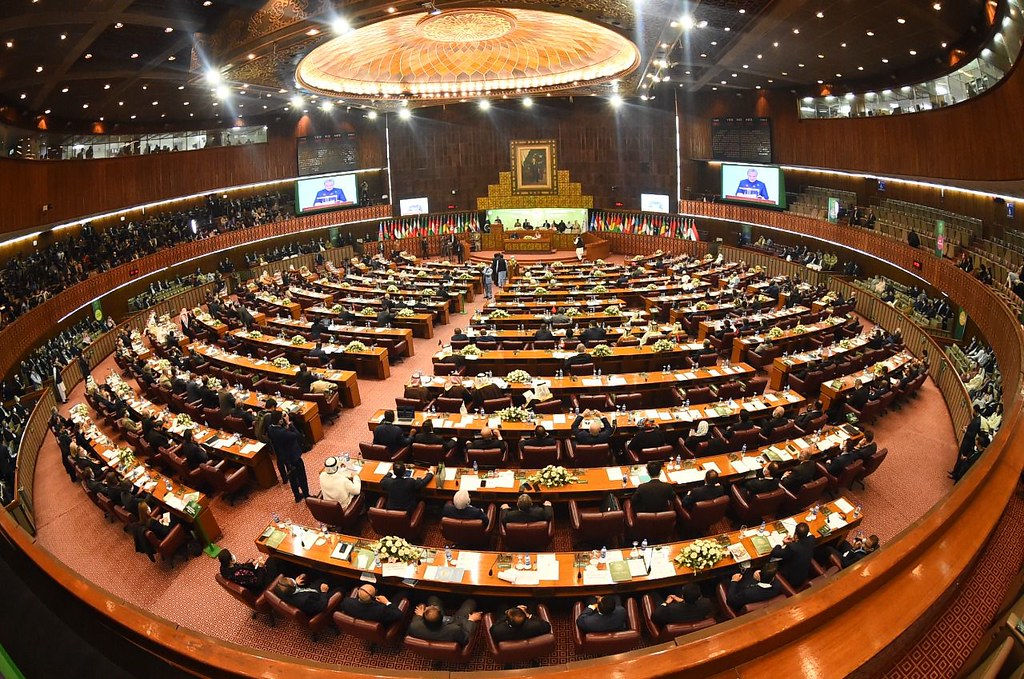
The Council of Foreign Ministries with their greater aim of becoming one voice for 1.5 billion Muslims across the world seeks to build partnerships among all the Islamic countries.
A United Front with one strong voice is what the Muslim world needs right now and the Organization of Islamic Conference (OIC) is the perfect body that can boost this unity with its coherently structured agenda.
In October 2020, Prime Minister Imran Khan wrote quite a hankering letter to the leaders of Muslim-majority countries. The letter depicted an urge to call for action against the growing tide of Islamophobia. He set forth a desire, “to act collectively to counter growing Islamophobia in non-Muslim states,” and the need for banding together to tackle this vicious wave. Undoubtedly, the letter was mainly pointed out the Islamophobic events unfolding in France that caused chaos in the country. However, he did not explicitly mention France in his letter but he pointed towards the growing threat of Islamophobia in the European countries where the Muslim population resides in a sizeable number.
Two years later, in 2022, The United Nations General Assembly (UNGA) adopted a resolution by consensus that was introduced by Pakistan on behalf of the OIC– proclaiming 15 March as ‘International Day to Combat Islamophobia.’ The resolution had the consensus of a 193-member world body and was co-sponsored by 55 Muslim countries. It highlights the right to freedom of religion and belief, recalling a 1981 resolution that called for the “abolition of all kinds of intolerance and discrimination based on religion or belief.”
The resolution caught appraisals from many countries but there was some sort of resentment towards the document from an obvious side. The representatives from India, France, and European Union were displeased on countries’ specified tilt towards a single religion and signaling out other religions. This resentment that was adopted by various countries is the sole reason why OIC is an important platform to advocate the rights of Muslims in countries where they are being violated. Ironically, the countries that showed discontent are the ones that promote the most of Islamophobia with their countries’ marginalized policies.
According to the Observatory, France and the United Kingdom had the greatest rates of Islamophobia-related actions, owing to government policies that appeared to suit growing far-right tendencies. The Observatory research also highlighted a similar tendency throughout Asia, particularly in India and Sri Lanka, where the situation has worsened due to ongoing hostilities in Myanmar between Buddhist monks and Rohingya Muslims.
Subsequently, the OIC is meeting this year on the 48th Session of the Council of Foreign Ministers in Islamabad. The theme for this year’s conference is “Building Partnership for Unity, Justice, and Development.” The Council of Foreign Ministries with their greater aim of becoming one voice for 1.5 billion Muslims across the world seeks to build partnerships among all the Islamic countries. With this aim of partnership and advocating Justice, the OIC aims to address multifaceted challenges that the Ummah is confronting around the world by becoming a strong Muslim block against the Western world.
The role of the OIC in this regard has increased over the years and has become predominant in the current scenarios. Especially during the times of Covid-19 when the Muslims around the world have witnessed widespread exclusionism. To combat all of these atrocities against the Ummah, the world needs a united block that can advocate for Muslims all across the world. The OIC in this regard has proven to be an extraordinary force whose objective is to unite the Ummah against all the dividing factors.
The OIC is the second-largest intergovernmental body after the United Nations. Due to the UN’s obvious tilt towards the western block, many of the Muslim world problems get lost in between. The OIC in this facet has thus proven a singular honor to bring the Ummah together as a cohesive entity, and to actively represent Muslims by endorsing all causes vital to the hearts of the world’s 1.5 billion Muslims. To preserve the essential interests of Muslims and to work toward the resolution of conflicts and disputes involving the Member States, the Organization has consultative and collaborative relations with the United Nations and other intergovernmental organizations.
In a similar vein, the Third Extraordinary Session of the Islamic Summit, convened in Makkah in December 2005, established the Ten-Year Program of Action to address the concerns of today’s world. At the end of 2015, it was completed. Since then, a successor program for the next decade (2016-2025) has been adopted. Through this strategy, the OIC is achieving its objectives and bringing about the desired change in the Muslim world. Its long-term plan of creating a Muslim block is by far all means a justified and rational that every Muslim country shall be vouching for.
On Wednesday, the OIC concluded its two-day meeting of Foreign Ministers with a strong 70-point Islamabad Declaration. The mere focus was on strengthened support for the people of Kashmir and Palestine. Shah Mahmood Qureshi while speaking to the conference, explicitly pointed at the issues of Kashmir and Palestine as glaring examples of injustice, oppression, and human rights violation. The participants of the OIC stated in the Islamabad Declaration;
“We declare that the final settlement of the Jammu and Kashmir dispute in accordance with UN Security Council resolutions is indispensable for durable peace in South Asia. We reiterate our call on India to: a) reverse its unilateral and illegal measures instituted since 5th August 2019; b) cease its oppression and human rights violations against the Kashmiris in IIOJK; c) halt and reverse attempts to alter the demographic structure and to redraw electoral constituencies in IIOJK; and d) take concrete and meaningful steps for full implementation of the UN Security Council resolutions on Jammu and Kashmir.”
The 48th session of the OIC CFM was of esteemed importance because of many reasons. One is the presence of Chinese Foreign Minister Wang Yi as a special Guest. In the history of OIC, it was for the first time that the Chinese Foreign Minister attended the meeting of Foreign Ministers where he stipulated the invested role of Beijing in the Muslim World. While the two Foreign Ministers exchanged views on myriad regional and International issues of mutual concern, the Chinese FM labeled OIC as bridging a positive route between China and the Muslim world.
The mission of OIC and the path that it is currently walking on is deemed to be a success in the coming future. To protect the genuine principles of Islam and Muslims, the group has taken several initiatives to dispel misconceptions and has fiercely fought for the abolition of all types of discrimination against Muslims. In line with its Charter, the OIC aims at preserving and protecting the common interests on the Member States and intensify efforts to address the difficulties confronting the Muslim world in particular, as well as the international community as a whole.
DISCLAIMER: The views and opinions expressed in this article are those of the author and do not necessarily reflect the official policy and position of Regional Rapport.